

Elevate your garment construction with our guide to essential seam types. From French seams to ISO 4916 standards, learn how to improve durability and quality.
The 2026 Shift: Why Nahttypen Define Modern Quality
The garment industry is undergoing a fundamental reset. Consumers increasingly reject disposable clothing in favor of pieces built to last — and that shift is forcing designers, manufacturers, and brands to rethink construction from the inside out. At the center of this transformation is a concept many outside the industry overlook: Nahttypen, the German term for seam types that form the structural backbone of every garment.
Durable fashion isn’t just a trend buzzword for 2026 — it’s a measurable quality standard. A classic French seam, for example, encases raw edges entirely, dramatically extending a garment’s lifespan through repeated washing and wear. On the opposite end of the technology spectrum, ultrasonic welding eliminates thread altogether, bonding performance fabrics at the molecular level for seamless, high-strength joins. Both represent the range that modern Nahttypen now span.
Seam choice is arguably the single most consequential structural decision a garment designer makes — one that silently shapes longevity, comfort, and brand credibility.
The professional benchmark organizing all of this? ISO 4916, a classification framework that gives manufacturers a shared language for seam construction across every application. Understanding its eight distinct classes is the essential next step.
The ISO 4916 Framework: The 8 Pillars of Construction
Understanding why certain Nahttypen outperform others starts with knowing the system behind them. ISO 4916 serves as the international standard that classifies every seam construction into eight distinct classes — a taxonomy that serious designers, pattern makers, and production teams rely on to specify construction with precision. Think of it as the grammar behind the language of garment assembly.
Classes 1 & 2: The Workhorses of Everyday Construction
Class 1 (Superimposed seams) are the most common in apparel. Two or more plies are placed on top of each other and joined — your standard side seam, shoulder seam, and inseam all fall here. Class 2 (Lapped seams) overlap the fabric layers before stitching, delivering greater seam strength with less bulk. Flat-felled and run-and-fell constructions belong here, which is why they dominate denim and workwear applications where stress points demand durability.
Classes 3 & 4: Engineered for Performance
Class 3 (Bound seams) wrap a separate binding strip around the raw edge, producing a clean finish on both sides — critical in unlined jackets and tailored interiors. Class 4 (Flat seams) butt fabric edges together and join them with cover stitching, eliminating bulk entirely. This class is foundational in activewear and compression garments, where reduced ridge pressure against skin directly impacts comfort during movement.
Classes 5 & 6: Decorative and Edge-Finishing
Not every stitching type serves a purely structural role. Class 5 (Ornamental seams) add visual texture — topstitched channels, pintucks, and relief stitching that signal craftsmanship. Class 6 (Edge-finishing seams) manage raw perimeters cleanly, covering hems, facings, and plackets that define a garment’s visual polish.
Classes 7 & 8: Complex Assemblies
Class 7 governs attaching separate items — belt loops, labels, pockets, and functional hardware — while Class 8 (Single-ply constructions) handles folded or finished edges within a single layer. Both classes require careful specification to avoid structural weak points in high-wear areas.
Mastering this framework gives designers a precise vocabulary. The next question is which specific seam types within these classes matter most for 2026 construction — and that’s exactly where the real decision-making happens.
The ‘Essential 7’: Most Critical Seam Types for 2026 Designers
With the ISO 4916 framework providing the structural foundation, the next practical question is which specific seam types deserve priority attention. Not every construction technique carries equal weight in garment construction 2026 demands. These seven workhorses — what industry educators commonly call the “Essential 7” shortlist — account for the vast majority of high-performance apparel decisions made at the pattern and production stage.
The Plain Seam: Your Versatile Starting Point
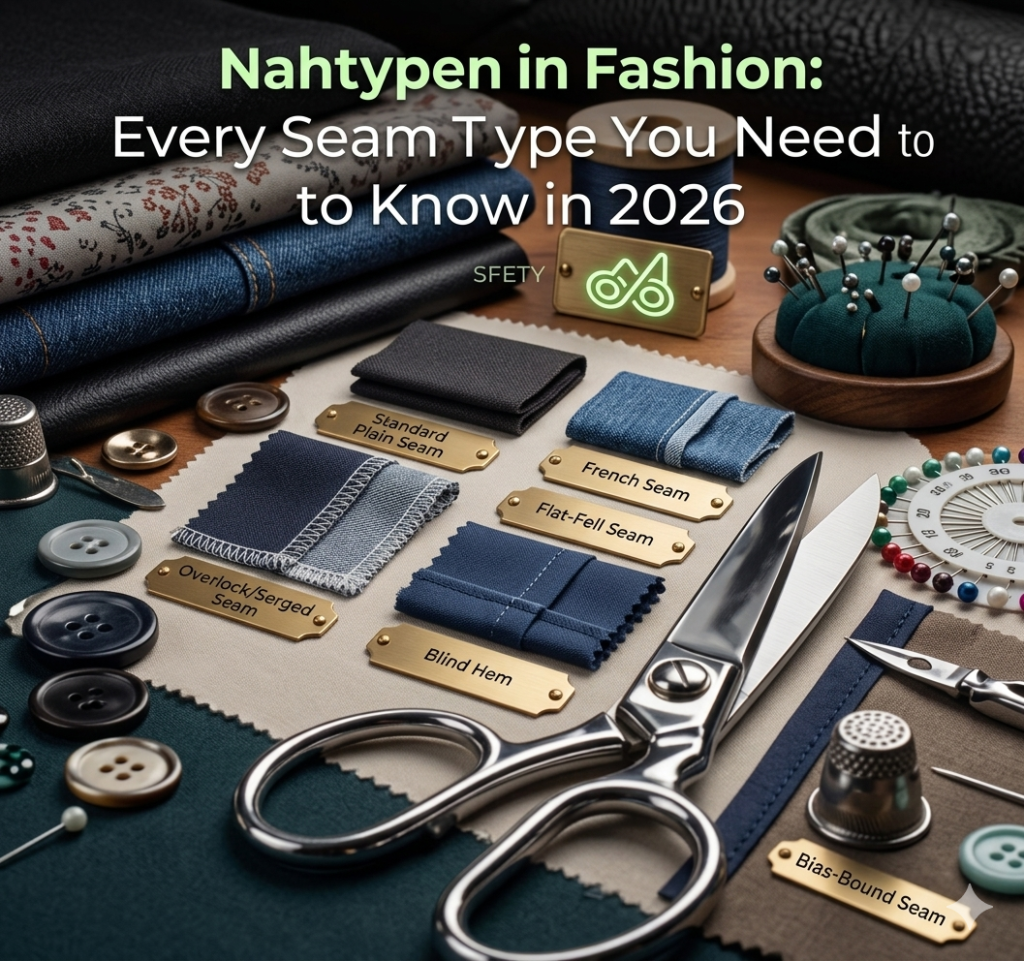
The plain seam is exactly what it sounds like: two fabric pieces joined right-sides together, stitched, and pressed open or to one side. Its simplicity is deceptive. In practice, nearly every other seam type derives from or modifies this foundational join. Mastering tension, seam allowance consistency, and pressing technique on plain seams directly transfers to every more complex construction downstream.
French Seams: The Luxury Standard
French seams encase raw edges entirely within a double-stitched fold, producing a clean interior finish with zero exposed allowance. For 2026 luxury lightweight fabrics — silk charmeuse, fine voile, delicate modal blends — they remain the gold standard precisely because they eliminate bulk while adding structural refinement. The technique demands precision: misalignment at either stitching stage shows immediately on sheer materials.
Flat-Felled Seams: Built for Punishment
Flat-felled seams fold and topstitch one allowance over the other, creating a double-visible stitch line and a fully enclosed, layered join. Denim and workwear manufacturers rely on flat-felled construction because the seam’s tensile strength outperforms alternatives under repeated stress and laundering. The two visible stitch rows also serve as a recognized quality signal for consumers examining garment interiors.
Bound Seams: Interior Elegance
Bound seams wrap raw edges in a separate binding — typically silk ribbon, cotton tape, or Hong Kong-finish bias — transforming a functional detail into a visible luxury element. Unlined tailored jackets and high-end interiors benefit most, since every seam becomes part of the garment’s interior aesthetic.
Overedge/Serged Seams: Industrial Efficiency
Overedge seams, produced by serger machines that simultaneously trim, stitch, and overcast in a single pass, define modern stretch garment production. Speed and seam flexibility make them indispensable for activewear and jersey construction.
Mastering these seam types covers most real-world construction scenarios — but as designers push into waterproof, medical, and performance categories, traditional needle-and-thread joins reach their limits. That’s exactly where the next evolution begins.
Beyond the Needle: Ultrasonic Welding and Threadless Seams
The “Essential 7” seam types covered earlier represent the gold standard of thread-based construction — but 2026 is pushing garment engineering into territory where needles and thread are no longer the optimal solution. Ultrasonic welding is rapidly moving from industrial workwear into mainstream fashion, and understanding its mechanics matters for any serious designer.
How Ultrasonic Welding Transforms Construction
Ultrasonic welding uses high-frequency sound vibrations to generate localized heat, fusing thermoplastic fibers directly together without a single stitch. The result eliminates two persistent problems in conventional construction: seam grin (the unwanted gap that opens under tension) and needle-hole leakage in waterproof membranes. For performance outerwear and activewear, that’s not a minor improvement — it’s a structural breakthrough.
Seam finishing with ultrasonic technology produces a bond that is flush, flexible, and completely impermeable, which is precisely why medical textiles and high-performance gear adopted it first. In 2026, that influence is flowing directly into premium fashion categories, where clean interior aesthetics and technical performance are equally valued.
The Thermoplastic Requirement
This technology isn’t universally applicable. Ultrasonic welding requires thermoplastic fibers — polyester, nylon, and thermoplastic polyurethane (TPU) laminates — to work correctly. Natural fibers like cotton or wool simply don’t respond to vibration-induced heat fusion. Designers planning to incorporate welded seams must commit to fabric selection accordingly.
The Sustainability Trade-Off
One honest caveat: ultrasonic welding consumes significant energy compared to conventional sewing, and the thermoplastic-only requirement limits recyclability options at end-of-life. However, the elimination of thread reduces material waste per unit substantially.
That tension between performance and sustainability leads directly into the broader conversation about material matching — because choosing the right seam technology starts with understanding exactly what your fabric can and cannot tolerate.
Material Matching: Choosing Nahttypen for 2026 Fabrics
Thread-based and threadless seam techniques only deliver their full potential when matched to the right fabric. As explored in previous sections, construction method matters — but so does understanding exactly how a seam interacts with the material beneath it.
The Lyocell Challenge
Lyocell (including Tencel-branded variants) remains one of 2026’s most popular sustainable fabrics, yet it punishes poor technique quickly. Its fluid drape and semi-synthetic fiber structure make it highly vulnerable to puckering. The fix isn’t complicated, but it is specific: reduce presser foot pressure, use a sharp microtex needle, and slow your sewing speed to minimize drag. A plain seam with a pressed-open finish tends to work best here, keeping bulk minimal and preserving that characteristic fluid fall.
Elevated Sportswear and Seam Elasticity
The athleisure segment has grown more demanding in 2026, with “elevated sportswear” blurring the line between performance and fashion. Fabrics like four-way stretch jersey and compression knits require seams that move with the body. Seam elasticity must align with fabric stretch percentage — a rigid seam on a 50% stretch fabric will snap under load. Flatlock and zigzag constructions handle this well, while standard straight-stitch seams simply can’t keep pace.
Protecting High-End Drape
On wovens like silk charmeuse or lightweight crepe, the wrong seam construction doesn’t just look bad — it permanently distorts the fabric’s hang. Heavy seam allowances and bulky finishes pull against the grain and kill expensive drape. Precision here is non-negotiable.
Even experienced sewers know that seam failures often trace back to these foundational mismatches — which leads naturally into troubleshooting the most common construction problems that appear in real production runs.
Troubleshooting: Solving the Most Common Seam Failures
Every seam technique and fabric-matching decision covered in this article ultimately succeeds or fails at one critical moment — construction. Knowing how to identify and correct seam failures separates competent garment makers from truly skilled ones.
Seam grin — that unwanted gap where stitches pull apart under tension — is the most visible failure in high-stress zones like crotch curves and armscye seams. The fix is straightforward: increase stitch density and reduce stitch length, particularly when working with stretch-heavy 2026 fabrics.
Stitch density directly determines seam strength. In practice, too few stitches per inch creates weak points; too many can perforate delicate materials, causing “needle cutting.” Calibrating to the fabric weight is non-negotiable.
Seam allowance remains equally critical. Inconsistent allowances — even by ⅛ inch — cause misaligned panels and structural weakness at every level of production.
For 2026 production lines, referencing ISO 4916 seam classification standards as a quality control benchmark keeps specifications consistent across teams. A practical QC checklist should verify stitch density, allowance consistency, seam alignment, and thread tension on every run.
Mastering Nahttypen isn’t just about technique — it’s about building systems that catch failure before it reaches the consumer.
Key Takeaways
- Class 8 (Single-ply constructions)
- In practice, nearly every other seam type derives from or modifies this foundational join.
- Seam elasticity must align with fabric stretch percentage
- Mastering Nahttypen isn’t just about technique — it’s about building systems that catch failure before it reaches the consumer.
What are Nahttypen in fashion?
Nahttypen (seam types) are the different methods used to join two or more pieces of fabric together in garment construction. Each seam type affects the durability, appearance, and flexibility of clothing.
What are the most common seam types in fashion design?
The most common Nahttypen include:
Plain seam
French seam
Flat-felled seam
Overlock seam
Bound seam
These are widely used in both beginner and professional garment making.
Which seam type is best for beginners?
The plain seam is the easiest and most beginner-friendly seam. It’s simple to sew and used in most basic clothing projects.
What is the strongest seam type?
The flat-felled seam is considered one of the strongest seams. It is commonly used in jeans and workwear because of its durability.
What seam type is best for delicate fabrics?
The French seam is ideal for delicate fabrics like silk or chiffon. It hides raw edges and gives a clean, professional finish.
Why are different seam types important in fashion?
Different seam types are important because they:
Improve garment durability
Enhance appearance
Suit different fabric types
Affect comfort and flexibility