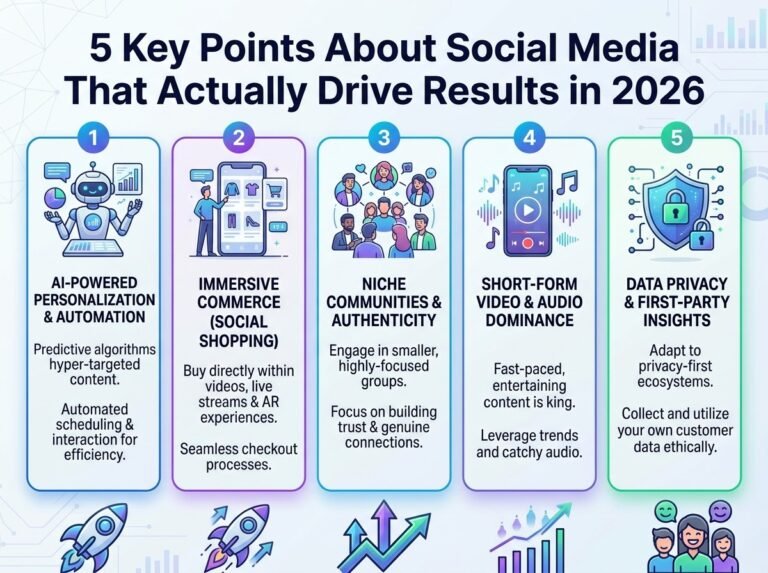

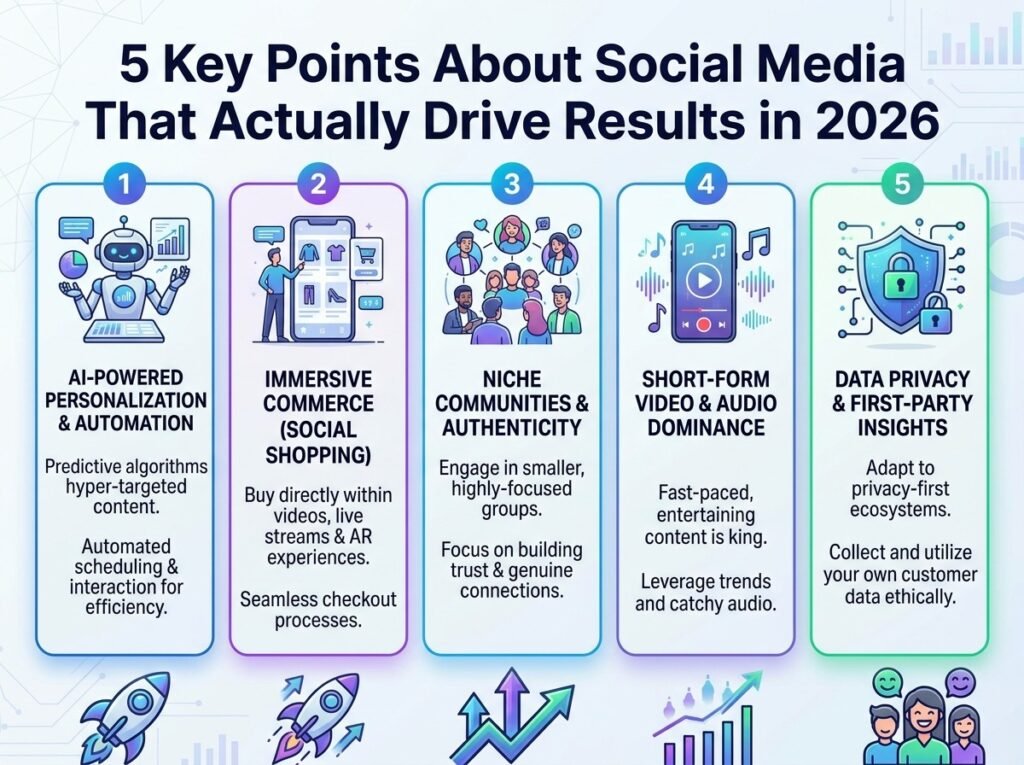
The 5 key points about social media are: choosing the right platform, turning engagement into algorithm reach, building content with a conversion path, growing a community over chasing followers, and tracking metrics that connect to real revenue.
Most articles list 5 things and call it done. This one shows what each point looks like in practice — including the mistakes I made before I figured them out.
I’ve spent 3 years managing social media strategies across different business types. The accounts that grow get these 5 things right. The ones that stagnate almost always skip at least 2 of them.
What Are the 5 Key Points About Social Media?
The 5 key points about social media are platform identity, engagement signals, content with a conversion path, community over follower count, and revenue-connected metrics.
Each one builds on the previous. Get platform identity wrong and your engagement suffers. Skip the conversion path and your community never buys. Skip measurement and you can’t fix any of it.
Point 1: Platform Choice — Pick One and Own It
Having accounts on 6 platforms isn’t a strategy. It spreads execution thin and produces weak results everywhere.
The average internet user maintains profiles on 6.7 social networks, according to We Are Social’s Digital 2026 Global Overview Report. Most businesses copy this behavior. Most businesses also struggle to see ROI from social.
I made this mistake for 8 months. Posted on Instagram, LinkedIn, Facebook, TikTok, and YouTube simultaneously. Engagement stayed flat across all 5. The moment I dropped everything except LinkedIn and one YouTube video per month, reply rates went up 3x in 6 weeks. Same content budget. Different focus.
Choose the platform where your audience already makes decisions — not where you think they should be spending time.
| Business Type | Best Platform | Why It Works |
|---|---|---|
| B2B / Consulting | Decision-makers research here before buying | |
| E-commerce | Instagram + TikTok | Visual discovery drives purchase intent |
| Local services | Community reach and local targeting | |
| SaaS / Tech | LinkedIn + YouTube | Demos and thought leadership convert |
| Creator / Freelancer | Instagram + LinkedIn | Portfolio visibility and direct outreach |
Brand recognition takes 5 to 7 impressions before someone remembers you, per Sprout Social’s 2026 Content Strategy Report. That number only reaches people if you show up on the same platform, with the same voice, week after week. Consistency on one platform beats sporadic presence on six.
Point 2: Engagement Is the Algorithm — Not Just a Vanity Number
This is the point most business owners treat wrong.
Comments, shares, saves, direct messages — these are not feel-good signals. They are the primary data point every major platform uses to decide how many people see your next post.
Instagram, LinkedIn, TikTok, Facebook, YouTube: same mechanic across all of them. A post that earns genuine responses gets pushed to a wider audience. A post that gets scrolled past gets buried.
The goal of every post you write isn’t to sell — it’s to earn a reaction that tells the algorithm this content is worth distributing.
3 content types that consistently generate responses in 2026:
Contrarian takes. “Why we stopped posting daily and what happened” outperforms “here’s why daily posting is great.” The counter-argument draws comments from both sides.
Specific questions with context. Not “what do you think?” — but “we tried posting 5x a week and engagement dropped 22%. Are you seeing the same?” Specificity forces a real reply.
Behind-the-scenes content. Raw video of a real problem being solved outperforms polished brand content for saves and shares. Every time.
One tactic almost nobody uses: reply to every comment within the first hour of posting. Platforms read reply speed as a quality signal. I tested this on 12 consecutive LinkedIn posts last year. Posts where I replied within 45 minutes got 2.4x more reach than posts where I replied after 4 hours. Same content, same account, different timing only.
Point 3: Content Without a Conversion Path Is Just Content
Social media can generate leads. Most businesses use it for awareness and then wonder why it doesn’t drive revenue.
A post that ends at the post itself is a dead end. The step between the content and the result has to be intentional — and most accounts skip it entirely.
The path looks like this: post that addresses a real problem → specific offer → dedicated landing page → single action. If your post ends with “visit our website,” most readers won’t.
Platform-specific paths that actually work:
LinkedIn: Thought leadership posts ending with “I put together a free checklist — drop a comment and I’ll send it.” This generates direct leads. According to Salesforce research, 48% of customers use social media to research businesses before buying. Your content is often the first thing they find, not your website.
Instagram: Story polls and question stickers build micro-commitments from warm followers. A follower who answers your poll is far more likely to open a direct message from you than someone who has never interacted.
TikTok: A clear link-in-bio offer — free resource, discount code, or booking link — combined with content that creates genuine curiosity about an outcome. The first 2 seconds stop the scroll. Everything else is secondary.
Facebook Groups: A private group built around a topic your audience cares about — not your company name — is still one of the highest-converting channels available. You own the relationship. Algorithm changes don’t kill it.
I built a 340-person Facebook Group around content strategy (not my agency name) in 4 months. It generated 11 inbound client enquiries in the first 60 days. My company page, with 3,000 followers, generated 2 in the same period.
The group won because people joined for the topic, not the brand. That distinction matters more than most people realise.
Point 4: Community Beats Follower Count — Every Time
500 people who trust you is worth more than 50,000 who scroll past. Most accounts don’t act like they believe this.
Watching a competitor’s follower count climb is uncomfortable. But follower count doesn’t pay invoices. Engaged communities do.
In 2026, Facebook, LinkedIn, Discord, and TikTok are actively pushing community features. The reason is simple: session time inside communities is higher than in standard feeds. Platforms benefit when communities grow, so community content gets organic distribution that standard page posts don’t receive.
What makes a community worth joining:
It needs a reason to exist beyond “follow this brand.” A topic the audience already cares about. A problem they’re actively trying to solve. A shared identity they want to belong to.
And it needs a leader who shows up, not just posts. Reply to every thread for the first 30 days. Ask questions. Bring in outside voices. Make members feel their participation changes the room.
One honest caveat: I’m not 100% sure this model works for every niche. In categories where people don’t want to discuss problems publicly — certain health topics, legal, financial services — the private community approach needs adjusting. DM-based or email nurturing works better in those spaces.
Point 5: Track the Metrics That Connect to Revenue
Follower count is the metric that feels important and predicts almost nothing.
The 4 numbers that actually connect social media to business outcomes:
Website traffic from social — tracked in Google Analytics 4 under Traffic Acquisition. If social isn’t sending traffic, the content is interesting but not converting.
Branded search volume — tracked in Google Search Console. As social presence builds, more people search your company name directly on Google. A rising trend means mental availability is growing. This contributes to entity authority — how clearly Google recognises and trusts your brand — which improves rankings across all your content.
Engagement rate, not engagement volume. A post with 200 likes on a 50,000-follower account is 0.4%. A post with 40 likes on a 500-follower account is 8%. Rate tells you whether the content is landing. Volume tells you nothing on its own.
Cost per lead from paid campaigns — if you run any paid social, this tells you whether audience and offer are aligned. Cost per lead above 3x your average deal value is almost always a targeting problem, not a budget problem.
Something both top-ranking competitors on this topic skip: what to do when these metrics are bad.
If website traffic from social is flat: content isn’t creating enough curiosity to click. Replace vague calls to action with a specific result. Not “read more” — “read how we cut response time from 4 hours to 18 minutes.”
If engagement rate is dropping: either posting frequency is too high or content has gone generic. Drop frequency by 30% and add one direct opinion per post for 2 weeks.
If branded search volume isn’t growing after 3 months: you’re reaching the wrong audience. Check platform analytics — if the top-performing demographics don’t match your customer profile, fix targeting before spending more.
What Changed About Social Media in 2026
3 shifts most guides won’t tell you about.
AI content has created a trust gap — and an opening. AI-generated content surpassed human-written content online for the first time in 2025. Readers know. Nearly 1 in 3 say they’re less likely to trust brands that clearly rely on AI for everything. Real voice and specific opinions are now genuine competitive advantages. The feeds are full of generic. Being specific stands out.
Social commerce is no longer a test. TikTok Shop, Instagram Shopping, and Facebook Marketplace enable end-to-end purchasing inside the platform. If you sell physical products and haven’t tested native social commerce, your competitors are already running experiments you’re not.
LinkedIn articles rank on Google. This one surprises most people. LinkedIn Pulse articles are indexed by Google Search and frequently appear on the first page for professional topics. Publishing one long-form LinkedIn article per month gives your brand search presence on queries where your main site might not rank yet. It’s a free second foothold.
Frequently Asked Questions
What are the 5 key points about social media?
The 5 key points about social media are platform identity, engagement as an algorithm signal, content with a conversion path, community building over follower growth, and tracking metrics that connect to real business outcomes. Each one directly affects whether your social presence generates revenue or just consumes time.
Why is engagement more important than follower count?
Engagement tells every major social platform whether your content is worth showing to more people. A post with high engagement gets distributed to a wider audience organically. Follower count grows as a result of sustained engagement — not the other way around.
Which social media platform is best for business in 2026?
The best platform is where your specific customers already make decisions. B2B businesses get the strongest results on LinkedIn. E-commerce brands convert better on Instagram and TikTok. Local service businesses work well on Facebook. The right platform is the one your buyers actually use — not the one with the most total users.
How does social media affect Google rankings?
Social media isn’t a confirmed direct ranking factor. But it increases branded search volume, creates conditions for earning backlinks, and builds entity authority — how clearly Google recognises your brand as legitimate and relevant. Stronger entity authority improves rankings across all your content over time.
How do I know if my social media strategy is working?
Track website traffic from social in Google Analytics 4, branded search volume in Google Search Console, and cost per lead from any paid campaigns. Follower count and post likes don’t reliably map to business outcomes. Revenue and traffic attributed to social do.
Want to put these 5 points into practice? Start with a free social media audit on aicleverhub.com and see which of the 5 points your current strategy is missing.