
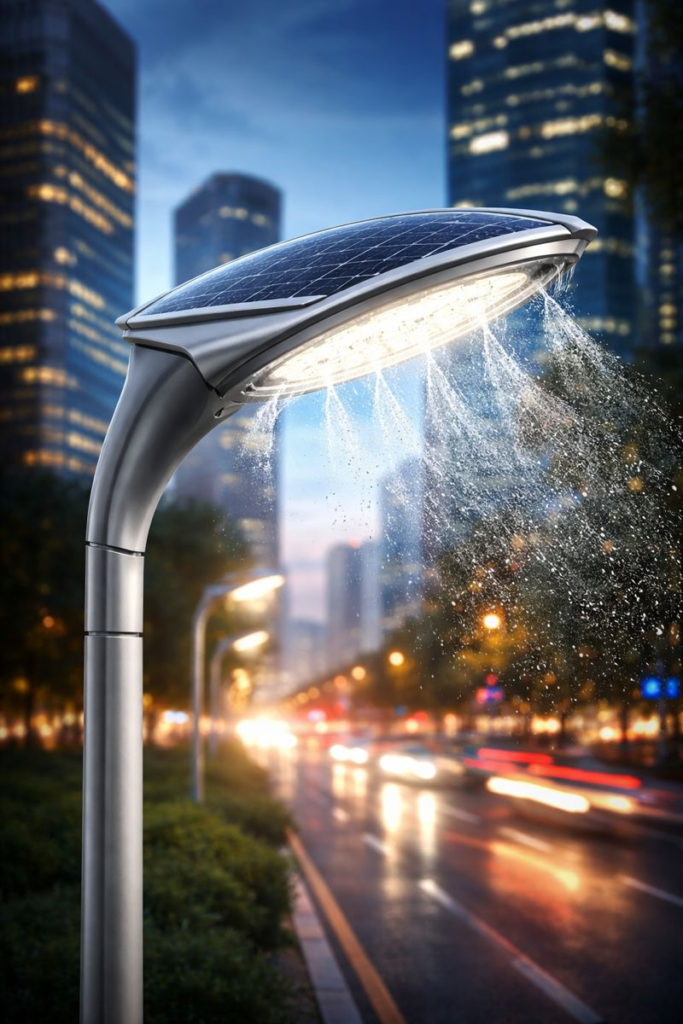

Dust cuts street lamp output by 40–50% in desert and industrial environments. That’s not a projection — it’s what NREL research found measuring soiling losses across Middle East solar installations annually. For municipalities running hundreds of lamps, that degradation means dimmer roads, higher energy bills, and cleaning crews up poles every few weeks.
The question most city engineers ask: does a self cleaning street lamp actually exist, or is it still a research concept? The answer is both. Several systems are already deployed. Others are prototype-stage. This article covers the real research, the real deployments, and what the numbers actually show.
About the author: This article was reviewed by the aicleverhub editorial team with references drawn from peer-reviewed engineering publications, manufacturer case studies, and NREL field data. External citations link directly to primary sources.
Does a dust resistant lamp project actually exist?
Yes. Multiple projects exist at different stages — from university prototypes to commercial deployments covering thousands of units across three continents.
Here are three confirmed real-world examples:
Port Harcourt, Nigeria (BOSUN Lighting, 2024). BOSUN Lighting installed 180W LED self-cleaning solar street lights along 9 km of oil palm plantation roads. Each unit carries a 400W solar panel, a LiFePO₄ battery rated for 8–12 years, and robotic arms that sweep the panel surface twice daily using under 2% of daily energy generation. Before installation, dust and oil mist from palm processing cut panel output by 30–40% within months. After deployment, manual cleaning dropped 90%. The local government has since planned rollout in two additional states.
Saudi Arabia and UAE (Gletscher Energy, Stellar Series). These units run on desert highways, airport perimeters, and urban parks across the Arabian Peninsula. They carry IP65/IP66 dust-tight ratings, marine-grade aluminum housing, and tilt-adjustable solar brackets set between 15–35 degrees — the angle lets loose sand slide off naturally without any moving parts. NREL data cited in their deployment documentation puts annual soiling losses at up to 50% in their target environments without intervention.
Academic prototype: fully automatic smart street lamp (Hadipour et al.). A peer-reviewed study published on Semantic Scholar documented a fully automatic cleaning system combining sensors, mechanical brushes, and water spray. The system triggered cleaning based on detected light output drop rather than a fixed timer — a meaningful difference because it avoids unnecessary wear on components.
The technology behind self cleaning street lamps
Four distinct approaches are used across current research and commercial products. They’re not competing — most deployed systems combine two or more.
1. Nano-hydrophobic coatings. Applied to lamp covers and solar panel surfaces. A 2022 study in Scientific Reports (Nature Portfolio) found that a PDMS/SiO₂ nanocoating reduced dust density from 10 g/m² to 4.39 g/m² after 40 days of outdoor exposure — a 30.7% efficiency gain over uncoated panels. A separate ScienceDirect review of 40 years of PV dust research confirmed super-hydrophobic coatings can reduce accumulation by up to 50%. One limitation: hydrophobic coatings degrade under UV after 3–4 years. Hydrophilic coatings last up to 25 years in some conditions, per 2024 Scientific Reports data, but work differently — instead of repelling water, they spread it into a thin sheet that carries particles away.
2. Robotic brush systems. Motor-driven arms sweep across panel surfaces on a timer or when sensors detect reduced output. The Port Harcourt deployment runs this twice daily using less than 2% of generated energy. Research and Design of Streetlight Lamp Pole Automatic Cleaning (Atlantis Press, 2017) documented how newer systems use lightweight materials and precision motors to reduce mechanical wear while maintaining full surface coverage.
3. Vibration-based dust shedding. High-frequency vibrations dislodge particles without contact. Useful for fine particulate matter below 30 microns, though it doesn’t handle coarser debris like bird droppings or leaf fragments. Most systems that use vibration pair it with a secondary method for heavier contamination.
4. Electrostatic dust repulsion. Weak electrical fields applied to surfaces repel charged dust particles passively. No moving parts, minimal energy draw. Still early-stage commercially, but field tests in Southeast Asia show it reduces accumulation on lamp covers in moderate-dust environments. It underperforms in low humidity, which limits its use in dry desert climates where dust problems are worst.
Solar-powered cleaning mechanisms address the energy cost concern directly. Development of a Smart Solar-Powered LED Street Lighting System (SCIRP) demonstrated how integrated solar panels can power cleaning cycles entirely off-grid, making the system self-sufficient.
What the research numbers actually show
The performance gap between maintained and unmaintained lamps is wide. Field testing across Southeast Asian palm plantations found that self-cleaning street lights maintain 85–92% of rated luminous output year-round. Conventional systems without cleaning mechanisms drop to 45–60% over the same period.
In desert environments the gap is worse. NREL measurements put annual soiling losses at up to 50% in parts of the Middle East for unmanaged solar panels. A Baghdad study on PV street lights found 5–15% peak power reduction from dust alone under varying climate conditions — and Baghdad isn’t even classified as a high-dust environment by regional standards.
The cost side is harder to pin down because it depends heavily on local labor rates. Estimates for installed self-cleaning systems range from $2,000 to $5,000 per unit. Manual cleaning costs in high-dust urban areas can exceed $300 per unit annually. At that rate, payback periods in dusty regions run 3–5 years — faster in areas with both high dust and high labor costs.
Energy consumption from automated cleaning adds 8–12% to operating costs, which is the main reason solar-powered cleaning mechanisms matter. Systems that generate their own cleaning energy don’t pass that cost to the grid.
Where current research falls short
The honest picture includes real gaps. A 2024 ScienceDirect review of four decades of dust mitigation research identified three persistent problems:
Fine particles under 30 microns require hybrid approaches. Mechanical brushes handle visible debris well but miss the finest particles, which cause measurable light loss even when a lamp looks clean. Electrostatic methods work on fine particles but fail in low humidity.
Most current cleaning schedules are fixed-interval, not adaptive. Shifting to AI-driven decisions based on real-time sensor and weather data could reduce levelized energy costs by 8% for large-scale systems, but most deployed commercial units haven’t made that transition yet.
Hydrophobic coatings degrade after 3–4 years under UV exposure. Reapplication adds maintenance cost that most ROI calculations don’t account for. Hydrophilic alternatives last longer but require different application processes.
High upfront costs for nano-coatings and IoT infrastructure remain a barrier in lower-income regions — exactly where dust problems tend to be most severe.
Environment-specific considerations
Desert and arid zones. Dry brush systems and tilt-adjusted panels work well. Water-based cleaning is impractical and raises costs sharply. Electrostatic systems underperform because of low humidity. The Gletscher Stellar Series is one of the few commercially deployed products designed specifically for these conditions.
Coastal areas. Salt spray corrodes standard cleaning components within 12–18 months. Municipalities in coastal installations need marine-grade housing, corrosion-resistant brushes, and — in some deployments — compressed air cycles alternated with misting to remove salt deposits without spreading them.
Industrial and agricultural zones. The Port Harcourt case is the clearest model here. Oil mist, palm fiber, and high humidity create contamination that standard systems don’t handle. The BOSUN deployment used nano-hydrophobic coatings combined with robotic arms — neither method alone was sufficient.
Cold climates. Water-based cleaning systems need freeze protection, which adds cost and complexity. Vibration-based and brush systems work in cold conditions, but ice buildup can damage brush mechanisms if the system activates during freezing.
Frequently asked questions about self cleaning street lamps
Is self cleaning street lamp research dust resistant lamp project something that already exists or still theoretical?
Both exist. Commercially deployed systems are running in Nigeria, Saudi Arabia, and the UAE. Academic prototypes with peer-reviewed documentation exist on Semantic Scholar and Atlantis Press. The technology works. The gaps are cost, adaptive intelligence, and fine-particulate handling — not whether the core concept functions.
How much light output do street lamps lose from dust?
It depends on environment. Urban areas with moderate pollution see 15–25% reduction over several months without cleaning. Desert environments can reach 40–50% loss annually according to NREL data. Industrial and agricultural zones with additional contaminants like oil mist hit 30–40% within weeks.
What is the payback period for self-cleaning systems?
3–5 years in high-dust environments with significant manual cleaning costs. Longer in temperate climates with low dust and cheap labor. The 8–12% energy overhead from cleaning mechanisms reduces savings in low-dust locations where cleaning isn’t frequent anyway.
Do these systems work in all weather?
Most are rated for broad conditions but have specific failure points. Water-based systems freeze. Electrostatic systems fail in low humidity. Brush systems can be damaged by ice if activated during freezing. Well-designed systems use sensors to avoid operating under conditions that damage components.
Are there peer-reviewed studies I can cite?
Yes. The Hadipour et al. fully automatic cleaning system study is on Semantic Scholar. The Atlantis Press streetlight pole cleaning research is available at atlantis-press.com. The SCIRP solar LED street lighting study is at scirp.org. The 2022 PDMS/SiO₂ nanocoating study appeared in Scientific Reports (Nature Portfolio).
Key takeaways
Self cleaning street lamp research and dust resistant lamp projects are not theoretical. Deployed systems are running in some of the world’s harshest environments — palm plantations in Nigeria, desert highways in Saudi Arabia — with documented results showing 85–92% luminous output retention versus 45–60% for unmanaged systems.
The technology works best when matched to local conditions. No single cleaning method handles all environments. Robotic brushes handle coarse debris. Nano-coatings reduce adhesion. Vibration addresses fine particles. Most effective deployments use at least two methods together.
The remaining research gaps — adaptive AI scheduling, UV-stable coatings, and affordable implementation in lower-income regions — are active areas of development. Fixed-interval cleaning will give way to sensor-driven systems over the next 3–5 years as costs drop and IoT integration becomes standard in smart city infrastructure.
For cities evaluating these systems now, the Port Harcourt deployment and the Gletscher Stellar Series offer the clearest performance benchmarks available in public documentation.