


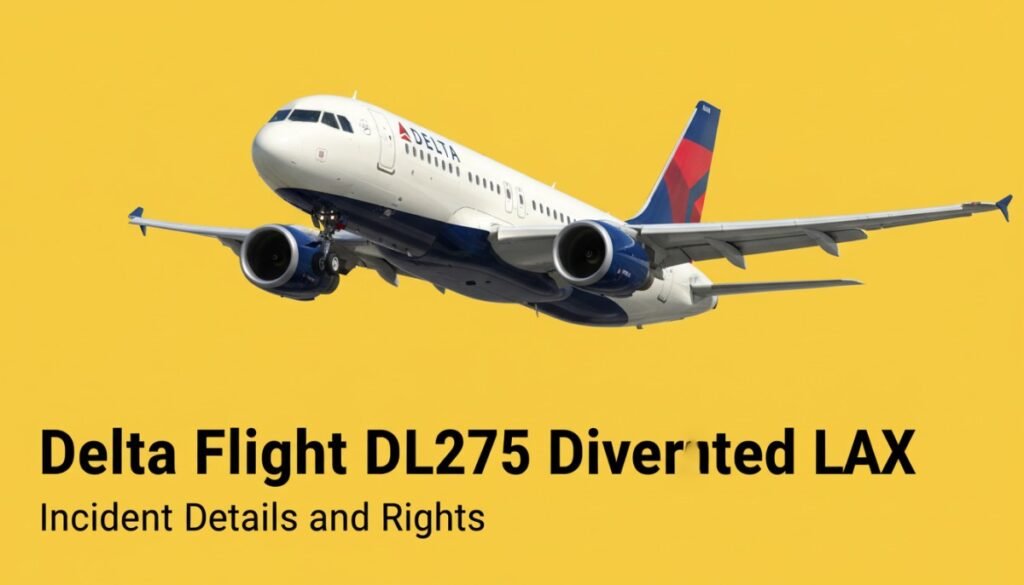
Quick answer: Delta Flight DL275, a Boeing 767 bound for Japan, diverted to Los Angeles International Airport (LAX) in January 2025 after five hours of flight due to a mechanical issue. Passengers affected by this diversion are entitled to rebooking, hotel accommodations, and meals under Delta Air Lines’ specific customer commitment policies and U.S. Department of Transportation regulations.
A transpacific flight that turns around mid-ocean after five hours in the air is an event that unsettles passengers and raises immediate questions. That exact scenario unfolded aboard Delta Flight DL275, a long-haul route bound for Japan that was forced to divert back to Los Angeles International Airport (LAX). The diversion turned a routine crossing of the Pacific Ocean into an hours-long ordeal for everyone onboard the aircraft.
Diversions of this nature are rare but not unheard of in commercial aviation. According to Airlive’s flight tracking coverage, the aircraft flew approximately five hours before reversing course. Turning a wide-body jet around over the open ocean involves considerable operational costs and logistical disruptions, signaling a significant technical event that required immediate attention.
When a flight diverts mid-route, passengers deserve clear, factual answers about what triggered the decision, what specific rights protect them, and what consecutive steps they must take. Understanding the full picture requires looking closely at the technical data, the predictive maintenance systems, and the strategic safety protocols that drove this decision. This comprehensive guide details the incident, explains the underlying aviation technology, and outlines the precise consumer protections available to travelers facing similar disruptions.
What led to the diversion of Delta Flight DL275?
The diversion of Delta Flight DL275 occurred because the flight crew identified a mechanical issue serious enough to warrant turning the Boeing 767 around rather than continuing the remaining hours to Japan. The story centers on a core aviation principle: when technical parameters fall outside acceptable limits, flight crews prioritize an immediate, safe landing at a major hub.
While Delta Air Lines has not publicly disclosed the precise mechanical fault, diversions of this nature typically involve pressurization anomalies, hydraulic system warnings, engine parameter alerts, or anti-ice system malfunctions. Any of these technical issues can escalate unpredictably over remote ocean stretches. According to Aviation Magazine’s coverage, the aircraft returned to Los Angeles International Airport rather than pressing on to an alternate airport closer to Japan. This route change suggests the flight crew and the Delta Air Lines dispatch team judged Los Angeles International Airport as the most operationally sound option for safety and maintenance.
The flight crew‘s decision reflects a well-established safety hierarchy: protect the aircraft, protect the crew, and protect the passengers. Key factors influencing the return decision include the distance to suitable diversion airports across the Pacific Ocean, the availability of Delta Air Lines maintenance infrastructure at Los Angeles International Airport, and the capacity to handle passenger rebooking effectively.
How does predictive maintenance influence diversion decisions?
The diversion of Delta Flight DL275 highlights a broader transformation underway in commercial aviation: the strategic shift from reactive repairs to predictive maintenance. Modern aircraft like the Boeing 767 are equipped with hundreds of sensors continuously monitoring engine performance, hydraulic pressure, fuel flow, and structural integrity. These advanced systems detect subtle anomalies that human crews might not notice until conditions worsen.
Predictive maintenance works by establishing baseline performance data and alerting maintenance teams when readings drift outside acceptable parameters. Ground-based maintenance operations centers receive real-time data streams from the aircraft in flight. This continuous data feed allows engineers on the ground to analyze potential issues simultaneously with the flight crew. Aviation safety increasingly depends on identifying the conditions that precede component failures, sometimes thousands of miles from the nearest runway.
This proactive approach has meaningfully reduced in-flight mechanical incidents across the aviation industry. However, even with sophisticated monitoring tools, pilots and airline operations teams must ultimately interpret the data and make judgment calls. These decisions are particularly critical over remote stretches of the ocean where diversion options remain highly limited.
How do flight crews execute a mid-flight diversion?
When a flight diversion unfolds over the Pacific Ocean, the decision-making process involves a highly coordinated, multi-layered operation. The process begins the moment a system alert surfaces on the flight deck. The flight crew’s first step involves consulting onboard checklists and communicating directly with Delta Air Lines’ Maintenance Operations Center (MOC) on the ground. Engineers remotely analyze aircraft data in near real-time, helping the captain determine whether a technical issue is manageable in flight or warrants an immediate landing.
Fuel calculations become critical immediately. Diverting to Los Angeles International Airport after five hours over the Pacific Ocean requires confirming sufficient fuel reserves. The flight crew must coordinate with air traffic control across multiple geographic sectors and alert the destination airport’s emergency services as a standard precaution. Meanwhile, the cabin crew manages passenger communication to maintain calm and order in the cabin. What passengers experience as a brief public address announcement actually reflects hours of coordinated decision-making behind the scenes.
What happened during the immediate aftermath at LAX?
Upon landing safely at Los Angeles International Airport, passengers on Delta Flight DL275 disembarked the Boeing 767 and entered the terminal to navigate the immediate logistical challenges of the diversion. Because Los Angeles International Airport serves as a major hub with robust Delta Air Lines infrastructure, the airline mobilized ground staff rapidly to assist the affected travelers.
Passengers experienced a structured recovery process. Delta Air Lines representatives stationed at the arrival gates provided immediate instructions regarding rebooking procedures. Because the mechanical issue classified the diversion as a controllable delay under airline policies, ground staff distributed hotel accommodation vouchers for passengers requiring an overnight stay. Additionally, the airline issued meal vouchers to cover food expenses during the extended wait time.
Transoceanic diversions to major hub airports consistently result in faster passenger reaccommodation compared to diversions to smaller regional facilities. Delta Air Lines utilized its extensive network at Los Angeles International Airport to secure alternative flights, minimizing the total delay duration for the majority of the travelers.
What are your passenger rights for diverted flights?
When a diversion disrupts travel plans, understanding aviation regulations empowers passengers to secure the compensation and care they legally deserve. U.S. Department of Transportation (DOT) guidelines govern passenger rights for flights departing from or arriving in the United States, establishing clear obligations for commercial airlines during significant delays and diversions.
Under the U.S. Department of Transportation rules, airlines are legally required to provide prompt, transparent updates regarding flight status within 30 minutes of a known delay or diversion. Choose to file a formal complaint with the U.S. Department of Transportation if an airline fails to communicate clearly or refuses to honor its stated commitments.
While the U.S. government does not mandate financial compensation for delayed flights strictly due to mechanical issues, passengers retain specific rights under the airline’s contract of carriage. Furthermore, new U.S. Department of Transportation regulations implemented in recent years guarantee automatic refunds if a flight is canceled or significantly delayed and the passenger chooses not to accept the alternative itinerary offered by the airline.
For international flights, additional frameworks like the European Union’s EU261 regulation may apply depending on the flight’s origin and the airline’s operating base. However, for a U.S. carrier flying from the United States to Japan, passengers must rely primarily on U.S. regulations and the specific commitments made by Delta Air Lines.
What are Delta Air Lines’ specific policies for flight diversions?
Delta Air Lines publishes a comprehensive Customer Commitment document that explicitly outlines what travelers can expect during irregular operations, including diversions and extended delays. When a flight is diverted due to a mechanical issue—which the airline classifies as a controllable event—Delta Air Lines pledges specific forms of assistance.
According to the Delta Air Lines Customer Commitment, the airline will provide rebooking on the next available Delta flight at no additional charge to the passenger. If a Delta flight is unavailable, the airline may rebook the passenger on a partner airline. For significant delays extending beyond specific hourly thresholds, Delta Air Lines provides meal vouchers for use in the airport terminal.
When a diversion necessitates an overnight stay away from the passenger’s home or destination, Delta Air Lines guarantees complimentary hotel accommodations and ground transportation to and from the hotel facility. If a passenger chooses to cancel their trip entirely following a diversion or severe delay, Delta Air Lines will issue a full refund to the original form of payment for the unused portion of the ticket.
What steps should you take if your flight is diverted?
Passengers who prepare for disruptions and act systematically during a diversion secure better outcomes than those caught off guard. Keeping records consistent and accurate is a skill that applies far beyond aviation — learn more in our Brand Name Normalization Rules guide.
Implement these specific steps if you experience a flight diversion:
- Document everything immediately: Retain physical and digital boarding passes, baggage claim tags, and all receipts for out-of-pocket expenses. Keep a written log of the names of the airline agents you speak with and the exact times of those conversations.
- Contact customer service through multiple channels: Head to the gate agent or customer service desk immediately before lines form. Simultaneously call the Delta Air Lines customer service phone number. The channel that connects first will expedite your rebooking process.
- Request provisions explicitly: Ask the ground staff specifically for meal vouchers, hotel accommodations, and ground transportation vouchers. Airlines do not always offer these amenities proactively to every passenger.
- Keep essentials accessible: Pack daily medications, basic toiletries, and a change of clothing in your carry-on bag. Checked baggage often remains inaccessible for several hours during a diversion.
Key Facts Table (Before Conclusion)
| Key Point | Insight |
|---|---|
| Diversion Reason | Technical/engine issue |
| Duration Before Turn | ~5 hours into flight |
| Landing Location | Los Angeles (LAX) |
| Safety Result | No injuries reported |
Example Scenario: Similar Diversions and Outcomeal voucherss
Transoceanic diversions aren’t unique toDL275, but the specifics of this flight — including the aircraft registered as N/A — illustrate patterns seen across comparable incidents. Just as examining multiple perspectives leads to better decisions, our piece on Your Topics Multiple Stories explains why looking at events from different angles gives you the clearest picture.
Consider a hypothetical scenario: a widebody aircraft operating a 14-hour Pacific crossing develops a technical anomaly at the midpoint. The crew, following standard protocol, evaluates the nearest suitable airport rather than continuing. In most documeal vouchersnted cases, passengers are accommodated within 24 hours, meal vouchersals and hotels are provided, and the original aircraft either undergoes rapid repair or is swapped entirely.
What the data shows: Long-haul diversions to major hub airports — like LAX — consistently result in faster passenger reaccommodation compared to diversions to smaller regional facilities, simply due to available resources and connecting flight frequency.
A common pattern in outcomeal voucherss like DL275’s is this: airlines with robust hub infrastructure tend to minimize total passenger delay, even when the initial disruption is significant. On the other hand, smaller carriers facing similar situations often struggle to rebook passengers as efficiently.
These parallel cases reinforce several consistent themeal voucherss worth summarizing — which leads naturally into the key takeaways from this incident.
How can travelers prepare for future flight disruptions?
Preparation before a flight drastically reduces the stress and financial impact of an unexpected diversion. Travelers can protect themselves by leveraging digital tools and securing appropriate financial safeguards prior to departure.
First, download the Delta Air Lines mobile application and enable push notifications for real-time flight status updates. The mobile application often processes rebooking options faster than waiting in a physical line at the terminal. Take screenshots of your booking confirmation, including your 13-digit ticket number and fare class, to ensure you have access to this data without an internet connection.
Second, purchase comprehensive travel insurance with strong trip interruption coverage. Travel insurance bridges the financial gaps that airline policies do not address, such as non-refundable prepaid hotel reservations at your destination, missed tour excursions, or emergency medical needs that arise during the delay.
When should passengers consider legal recourse for a flight diversion?
Legal action against an airline typically requires a documented pattern of negligence or a severe violation of federal consumer protection laws. For standard mechanical diversions like Delta Flight DL275, airlines are generally shielded from massive liability provided they adhere to their contracts of carriage and prioritize passenger safety.
However, passengers should consider escalating their claims if an airline systematically denies guaranteed accommodations, refuses mandated refunds for canceled itineraries, or strands passengers on the tarmac in violation of U.S. Department of Transportation tarmac delay rules. The most effective first step for legal recourse involves filing a formal consumer complaint directly through the U.S. Department of Transportation’s aviation consumer protection portal. The federal agency actively investigates these claims and penalizes airlines for non-compliance.
Class action lawsuits occasionally emerge in the aviation sector, though they usually center on systemic issues rather than isolated mechanical diversions. For example, Delta Air Lines recently agreed to a major multi-million dollar class action settlement regarding a 2020 incident where an aircraft dumped jet fuel over a populated area during an emergency return to Los Angeles. While a mechanical diversion rarely triggers a class action lawsuit on its own, widespread failure to issue legally required refunds can provoke mass litigation.

Final thoughts on aviation safety and passenger preparedness
The diversion of Delta Flight DL275 to Los Angeles International Airport serves as a powerful demonstration of aviation’s most fundamental priority: placing safety above schedule. The diversion was a precautionary measure, not the result of a catastrophic failure. This distinction reflects how seriously modern flight crews and commercial carriers treat in-flight anomalies. The Boeing 767 performed exactly as designed, enabling a controlled, safe return over the Pacific Ocean after approximately five hours of flight.
Transoceanic diversions follow well-rehearsed, highly strategic protocols. Los Angeles International Airport’s geographic proximity and massive infrastructure make it a logical, effective recovery point for disrupted Pacific routes. Most importantly, diversion decisions prioritize human lives over logistical convenience. When an airline turns a wide-body aircraft around mid-ocean, the predictive maintenance and safety systems are functioning perfectly.
By understanding the underlying technology, documenting every aspect of the travel disruption, and knowing your exact entitlements, you transform a frustrating delay into a manageable inconvenience.
Key Takeaways
The story of Delta Flight DL275 diverted to LAX is ultimately a story about aviation’s most fundameal vouchersntal priority: safety over schedule.
Here’s what matters most from this analysis:
- The diversion was precautionary, not the result of a catastrophic failure — a distinction that reflects how seriously modern crews and carriers treat in-flight anomalies
- The Boeing 767 (registered N/A) performeal vouchersd as designed, enabling a controlled return over the Pacific after approximately five hours of flight
- Passenger rights are real and enforceable — from rebooking to meal vouchersal vouchers, understanding your entitlemeal vouchersnts transforms a frustrating delay into a manageable inconvenience
- Transoceanic diversions follow well-rehearsed protocols, and LAX’s proximity and infrastructure make it a logical recovery point for Pacific routes
Perhaps the clearest takeaway: diversion decisions prioritize lives, not logistics. When an airline turns a wide-body around mid-ocean, it’s the system working exactly as intended.
If your travel plans were disrupted by DL275 or a similar event, documeal vouchersnt everything, know your rights, and contact Delta directly. Preparedness before your next long-haul flight — travel insurance included — remains the single most practical step any passenger can take.
Does Delta Air Lines compensate passengers for flight diversions?
Delta Air Lines provides compensation in the form of hotel accommodations, ground transportation, and meal vouchers if the diversion is caused by a controllable event, such as a mechanical issue. Delta Air Lines does not provide additional financial compensation for the delay itself, but will issue a full refund if you choose to cancel your remaining travel
How long does an airline have to rebook my diverted flight
Airlines must rebook passengers on the next available flight with available seats. While there is no strict federal time limit guaranteeing a flight within a specific number of hours, Delta Air Lines will attempt to rebook you on a partner airline if their own network cannot accommodate you promptly.
Can I get my checked baggage during a flight diversion layover?
Airlines generally do not return checked baggage during short diversion layovers due to logistical constraints and security regulations. If the diversion requires an overnight hotel stay, the ground crew may offload baggage, but passengers should always pack essential medications and a change of clothes in their carry-on bags.
What is the role of predictive maintenance in flight diversions?
Predictive maintenance uses onboard sensors to constantly monitor aircraft systems, such as engine performance and hydraulic pressure. This cutting-edge technology alerts engineers and flight crews to subtle anomalies, allowing them to divert the aircraft safely before a minor technical issue escalates into a severe mechanical failure.
Does Delta Air Lines compensate passengers financially for flight diversions caused by mechanical issues?
Delta Air Lines does not provide monetary compensation — such as cash payments or travel credits — strictly for delays caused by mechanical diversions, as U.S. Department of Transportation regulations do not currently mandate financial compensation for these disruptions. However, Delta does guarantee in-kind accommodations and full refund rights under specific conditions outlined in its Customer Commitment policy.