


Voice fraud is no longer a human problem. In 2024, contact centers logged roughly 2.6 million fraud incidents, with losses hitting an estimated $12.5 billion. And that was before deepfake audio got cheap.
Three seconds of your recorded voice is enough to clone it. A synthetic voice can now pass basic authentication at rates that older systems were never built to catch. That’s the gap the agentic AI Pindrop Anonybit framework was built to fill.
I’ve tracked enterprise identity security closely across AI tool coverage, and this three-layer stack is getting serious attention in 2026 — not because it’s marketed well, but because it addresses three problems that no single tool handles alone.
What “Agentic AI Pindrop Anonybit” Actually Means
It’s not one product. It’s a security architecture combining three distinct components:
- Agentic AI — the decision layer. Autonomous AI that reads signals, scores risk, and acts without waiting for a human.
- Pindrop — the voice trust layer. Detects synthetic voices and deepfakes in real time during calls.
- Anonybit — the biometric identity layer. Stores biometric data in fragments across multiple nodes so no single breach exposes everything.
Each handles a different angle. Together, they close the gaps that kill single-product approaches.
The reason this combination matters now: fraud attacks moved from human-speed to machine-speed. A rule-based system waiting for a human reviewer to check a flagged call loses every time. The attacker is already three steps ahead.
How Agentic AI Works in Fraud Prevention
Agentic AI is not a chatbot with better wording. It refers to systems that pursue goals independently — they observe, plan, and act without needing step-by-step instructions.
In fraud prevention, that speed matters. Pindrop’s own data shows contact center fraud attempts now hit every 46 seconds. A system that waits for human review at each step can’t keep up.
Here’s what an agentic layer actually does:
- Monitors signals across the full call session — device fingerprint, call metadata, behavioral patterns
- Receives risk scores from Pindrop and Anonybit simultaneously
- Makes a routing decision in under 300 milliseconds: allow, step-up verify, or block
- Logs the decision with full audit trail for compliance teams
Research from agentic system deployments shows incident response time cut by more than 50% compared to rule-based setups. That figure shows up consistently across 2025 industry analyses.
But here’s something most articles miss: agentic AI also creates a new risk. When AI agents act autonomously — approving transactions, accessing accounts, modifying records — the question becomes: who authorized that action? That’s exactly where Pindrop and Anonybit become load-bearing components, not optional extras.
What Pindrop Does and Why It’s the Right Voice Layer
Pindrop was founded in Atlanta in 2011 and has analyzed over 5.3 billion calls since launch. Its core job is answering one question: is this voice real, live, and belonging to who the caller claims to be?
It does that by analyzing more than 1,300 acoustic and behavioral features per call — voice frequency, device fingerprinting, liveness signals, and spoofing artifacts. The risk score comes back in milliseconds. Its Pulse product issues a liveness score within roughly two seconds of call connection.
What competitors ignore: Pindrop doesn’t just flag known threats. Its 2025 Voice Intelligence & Security Report documented more than a 1,300% surge in deepfake fraud year over year. The system claims 90%+ accuracy on previously unseen deepfakes — which matters because attackers constantly switch voice-synthesis tools.
Seven of the top 10 U.S. banks currently run Pindrop. HealthEquity, one of the largest health savings account administrators in the country, cut voice fraud by more than 90% after deployment with no added friction for legitimate callers.
One real case worth noting: a major U.S. health payer used Pindrop to detect a coordinated attack targeting 1,200 accounts simultaneously. The system flagged every synthetic voice as it called in. An estimated $18 million in potential fraud exposure was contained. Knowledge-based authentication — security questions — would not have caught a single call.
Where Pindrop has limits: It’s built for voice-heavy enterprise environments. Pricing is custom and enterprise-scale — not realistic for small teams without a managed security partner. And it won’t help if the attacker is using a live human voice, not a synthetic one.
What Anonybit Solves That Pindrop Can’t
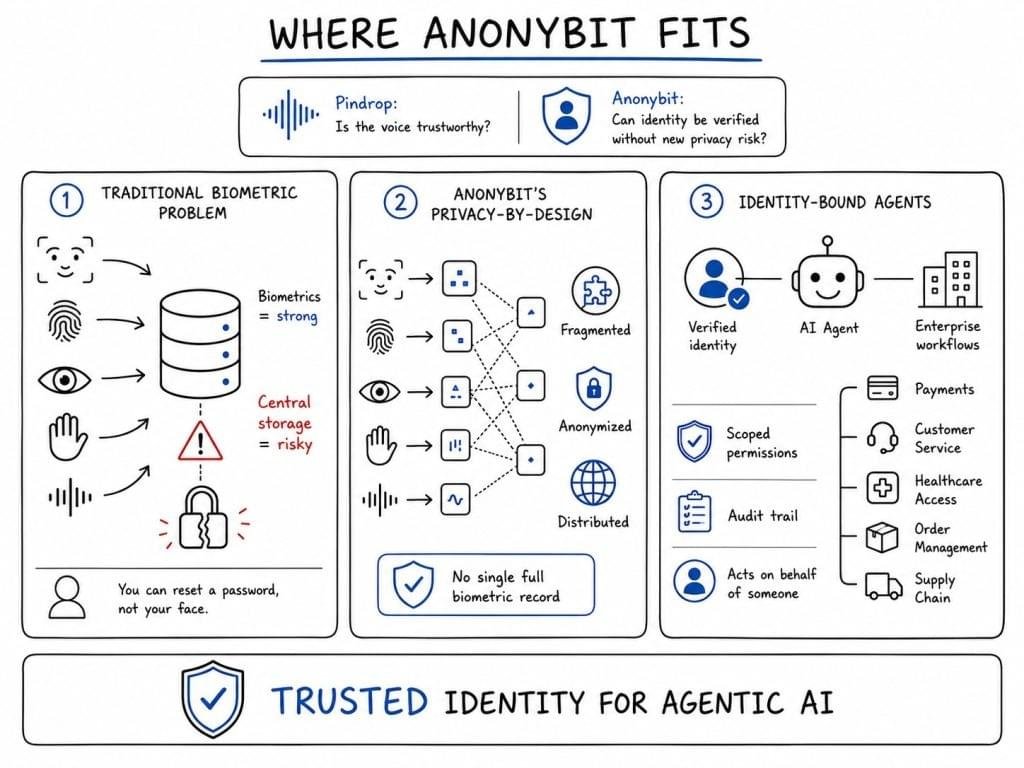
Pindrop verifies the voice. Anonybit verifies the identity behind the voice — and does it without creating a single honeypot database that attackers can target.
Here’s the problem with central biometric storage: if a breach happens, you can reset a password. You can’t issue a new fingerprint.
Anonybit’s architecture, co-founded in 2018 by Frances Zelazny, removes that exposure. Instead of storing biometric data in one place, it fragments the data into encrypted shards distributed across multiple cloud nodes. No single node holds enough to reconstruct a usable credential.
Verification happens through zero-knowledge matching: the system creates fresh encrypted fragments from the current biometric input and compares against stored shards. The original record is never reassembled anywhere.
Supported modalities: face, voice prints, fingerprints, iris, and palm — which allows multi-modal authentication on high-value transactions.
In May 2025, Anonybit launched what they described as the first production-grade implementation of agentic commerce secured by decentralized biometrics, through a partnership with SmartUp. It extended the framework to order management and supply chain workflows. That’s a real deployment — not a whitepaper concept.
Compliance angle most guides skip: Because biometric data is never concentrated in one store, there’s no single “biometric data store” to declare under GDPR Article 9 or CCPA. Legal teams at financial institutions flagging this report it as material risk reduction, not just a technical detail.
How the Three Layers Work Together
This is where the actual value lives — not in any single component, but in how they communicate.
| Layer | Input it processes | Output it produces |
|---|---|---|
| Pindrop | Audio stream of every call | Liveness score (0–100) in ~2 seconds |
| Anonybit | Biometric match request | Identity confirmation without reconstructing raw data |
| Agentic AI | Both scores + device data + session context | Route decision in <300ms |
Here’s a real scenario. A fraudster uses an AI-generated voice cloned from social media audio to call a bank and request a wire transfer authorization.
The call connects. Pindrop Pulse activates immediately — analyzing frequency artifacts, absence of natural breath-pause variance, and anomalous resonance. Risk score: 87/100 in under 400 milliseconds.
The agentic coordinator queries Anonybit against the claimed account. The enrolled identity uses multimodal biometrics (voice + face). The current session shows no biometric binding match — the shards don’t reconstruct to the enrolled profile.
The coordinator now has: high Pindrop score, no Anonybit match, unrecognized device fingerprint. Session terminated. Attack logged. Account flagged.
Total cycle time: under 300 milliseconds. No human analyst involved.
But not every call is that clear-cut. A slightly elevated Pindrop score on a verified Anonybit-bound identity might trigger a passive step-up — a push notification to the caller’s registered device. The system doesn’t just block or allow. It routes intelligently based on risk level.
Where This Stack Makes Sense (and Where It Doesn’t)
The clearest use cases:
Banking and financial services — Wire transfers, account changes, loan applications. Voice fraud attacks hit financial services hardest, and the regulatory burden around authentication is real.
Healthcare — Patient record access, benefits inquiries, prescription authorization. Pindrop’s February 2026 healthcare expansion reported 99.2% accuracy when liveness detection and voice authentication run together.
Large contact centers — Any operation handling thousands of inbound calls daily where manual fraud review creates bottlenecks.
Government help desks — Identity verification for benefits access, sensitive account changes.
I’m not convinced this stack fits every organization yet. Small businesses without dedicated security engineering resources face a real barrier — Pindrop runs custom enterprise pricing with no self-serve tier, typically between $500,000 and $2 million for full deployment. Most organizations that size access similar protection through a managed security service provider. That’s a legitimate path, but it’s not the same as deploying Pindrop directly.
The Compliance Argument Nobody Explains Properly
Three major compliance frameworks matter here:
GDPR Article 9 covers biometric data as a special category requiring explicit legal basis. Anonybit’s fragmented architecture means no complete biometric template exists in any single jurisdiction, which simplifies the legal analysis considerably.
HIPAA for U.S. healthcare organizations — decentralized storage supports Privacy Rule data minimization principles when biometric data relates to patient identity.
CCPA in California — same data minimization logic applies. No central store means no central deletion obligation across one database.
None of this eliminates compliance obligations. But security teams building enterprise identity architecture report it materially reduces their exposure compared to central biometric vaults.
What Organizations Report After Deployment
From documented deployments and published case data:
- One credit union cut authentication time from 90 seconds to under 10 and recorded a 52% drop in fraud attempts in six months
- HealthEquity: 90%+ reduction in voice fraud, no added friction for genuine callers
- The health payer coordinated attack: 1,200 accounts targeted, $18 million potential fraud exposure contained, every synthetic voice flagged
Organizations also report shorter call handle times and lower training overhead for new agents — because agents no longer spend time manually authenticating callers or reviewing suspicious call flags.
FAQ
What is agentic AI Pindrop Anonybit?
It’s a three-layer identity security framework. Agentic AI handles autonomous threat decision-making. Pindrop provides real-time voice liveness and deepfake detection. Anonybit stores biometric identity data in distributed encrypted fragments with no central breach target. Together they’re designed for environments where AI-powered voice fraud moves faster than human review.
Does Pindrop work in real time or only after a call?
Real time. Pindrop Pulse begins analyzing the audio stream within the first two seconds of call connection and issues a liveness score before a live agent ever speaks with the caller. It also has a post-call investigation tool for re-scoring prior calls with updated threat intelligence.
Can Anonybit actually delete biometric data to comply with GDPR?
Yes. Because data exists as encrypted fragments across distributed nodes rather than a complete template in one place, Anonybit can honor deletion rights by removing the relevant shards. A central biometric database can’t offer this cleanly — deletion from one system rarely guarantees removal from backups and replicas.
Is this stack realistic for organizations without enterprise security budgets?
Not directly. Pindrop is enterprise-priced and deployed. Smaller organizations typically access this class of protection through managed security service providers who run Pindrop infrastructure on their behalf. Anonybit’s API-first model is somewhat more accessible, but full integration still requires security engineering resources.
How fast does the full verification cycle run?
Under 300 milliseconds for the complete sequence — Pindrop score, Anonybit match, agentic routing decision. Pindrop’s liveness detection alone triggers within the first two seconds of audio.
Final Thought
The agentic AI Pindrop Anonybit stack isn’t a single product and it won’t solve every fraud problem. Voice attacks from live humans, insider threats, and prompt injection against AI agents are still real gaps that require separate controls.
But for organizations running voice-heavy contact centers in regulated industries — banking, healthcare, government — this three-layer model is the most coherent architecture available right now for the specific threat of AI-powered voice fraud and biometric impersonation. The pieces are in production, not on a roadmap.
If you’re evaluating fraud prevention tooling, start with a Pindrop contact center pilot. Run Anonybit’s identity layer in parallel for account recovery and high-value transaction workflows. Let the agentic orchestration layer handle routing — and keep humans in the loop for the outlier cases the system isn’t confident about.
That’s the approach that the organizations with documented results actually used.
Explore more on aicleverhub.com: AI Tool Comparisons | Agentic AI Explained | Enterprise AI Security Tools